
Getting Todd County Court Records
Minnesota Court Records Online, or MCRO, is the free statewide starting point. Case Search tracks down public Todd County matters by a solid name, a full case number, a citation number, or an attorney. Open a case and you get the Register of Actions. You also get any documents the rules allow the public to see. Searching costs nothing. The downloads currently offered are free too. Remember the catch. Everything there is unofficial. For a certified copy, a paper file held locally, an older item, or hands-on help, turn to Todd County Court Administration. Do not treat a screen result as the final word.
- Use MCRO Case Search to identify the Todd case and open its Register of Actions.
- Write down the court file number and the document title, date, or index number needed.
- Use the online document route for a public item, or ask Court Administration by phone, in person, or by mail for a local, certified, or unavailable record.
- Complete the statewide copy form or a letter with the case type, case number or county, parties, exact document, copy type, quantity, and delivery choice.
- Confirm the current fee, payment method, and expected completion time before sending payment or relying on a copy.
Mail requests belong with the court administration in the county where the case was filed. That county is not necessarily Todd. The copy form offers mail, pickup, or prepaid courier delivery. Fax and email work only for plain, nonconfidential copies. Court Administration will walk you through the records process, though it cannot give legal advice about what a case result means.
Todd Court Record Search in MCRO
MCRO is the statewide public layer for any Todd District Court case. Pick the narrowest search the facts allow. When you know the county, select Todd under specific county court locations. A full court file number or citation number can carry dashes and leading zeroes or leave them out. Spaces are never allowed. An incomplete identifier just returns an error. Name searches tell you less. Results can be thin for pending traffic, criminal, and petty-misdemeanor matters that lack a conviction, so an empty name result does not mean no court event exists.
Minnesota’s case-record access overview separates remote MCRO searches from the broader electronic access you get at courthouse public terminals. Those terminals still honor confidentiality, sealing, juvenile, medical, and other limits. They are a practical fallback for a Todd court record search. The public route may hide the item you need.
The Judicial Branch’s access overview lays out every route a Todd court record search can take.
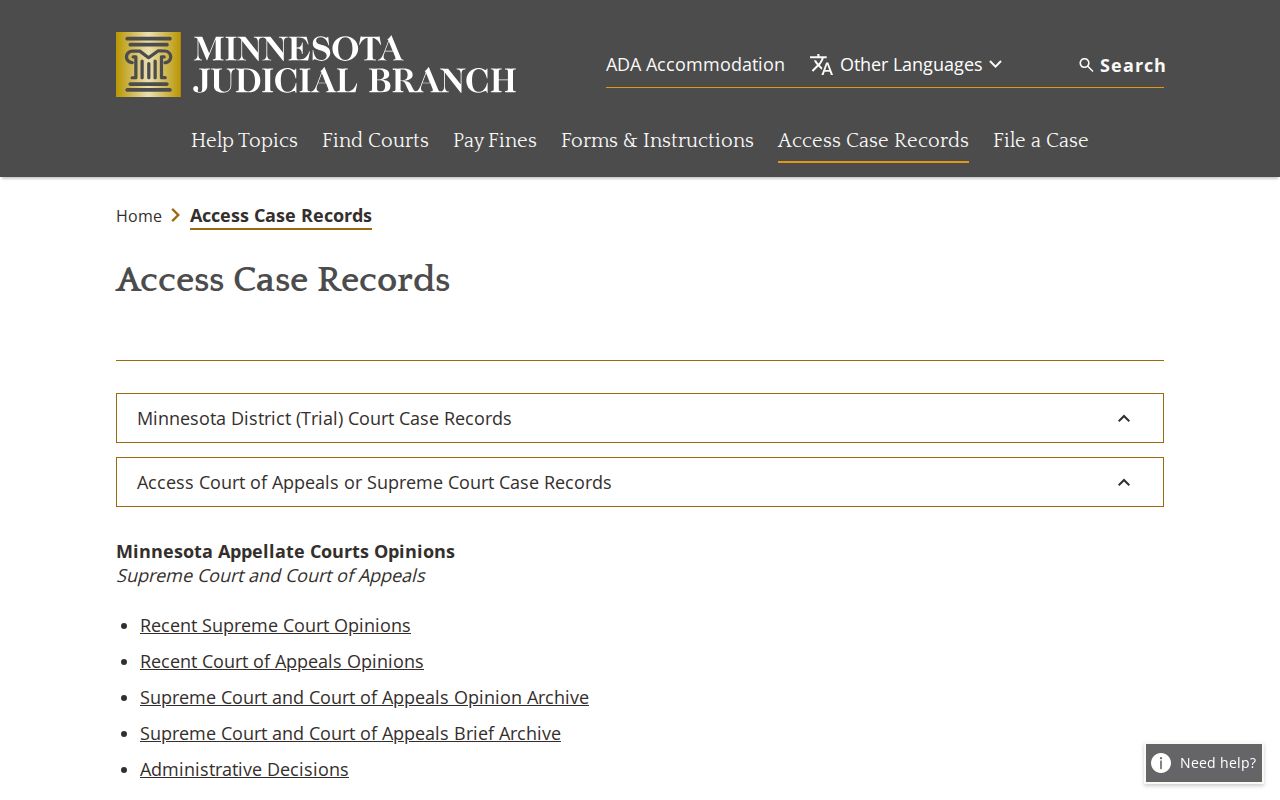
Those routes split the work. Online searching, courthouse terminals, local files, and court-administration assistance each cover a different gap rather than one universal copy channel.
Court Record Types
Todd County Court Administration handles civil, family, probate, juvenile, criminal, and traffic matters. It also covers related Minnesota District Court business. What is public depends on the case type. It also depends on the document itself, its date, and the governing access rule. The Register of Actions is only a chronological index of case activity. It is not every filed document, exhibit, transcript, or authenticated copy.
- Case information and Register of Actions: case category, parties or roles where public, events, filings, hearings, and orders.
- Public documents: permitted pleadings, notices, orders, judgments, and related items available through MCRO or the clerk.
- Judgment information: public judgment details and satisfactions where available through the separate MCRO judgment search.
- Certified or exemplified products: authenticated copies produced by Court Administration, not by an MCRO download.
- Records with special limits: juvenile, sealed, confidential, medical, and restricted materials governed by law or order.
Todd Court Record Document Search
Once Case Search gives you a full case number, MCRO Document Search becomes useful for a Todd County court record search. The box reads “Enter Case Number,” with buttons to clear it and to find documents. Names alone will not work. Partial numbers will not either. Results, when a document is available, list newest first. They may include the title, the linked event or date, print controls, and a permitted view of the file.
When a document is missing, do not assume it was never filed. It may be confidential. The item may sit outside the public document scope, be too old for the online availability rule, or simply not be imaged for remote access. Covered case types carry broader public access from July 1, 2015 forward; older material is thinner. For one specific missing item, ask Todd Court Administration.
The official Document Search screen makes plain why a Todd County court record document search needs the complete number before it can run.
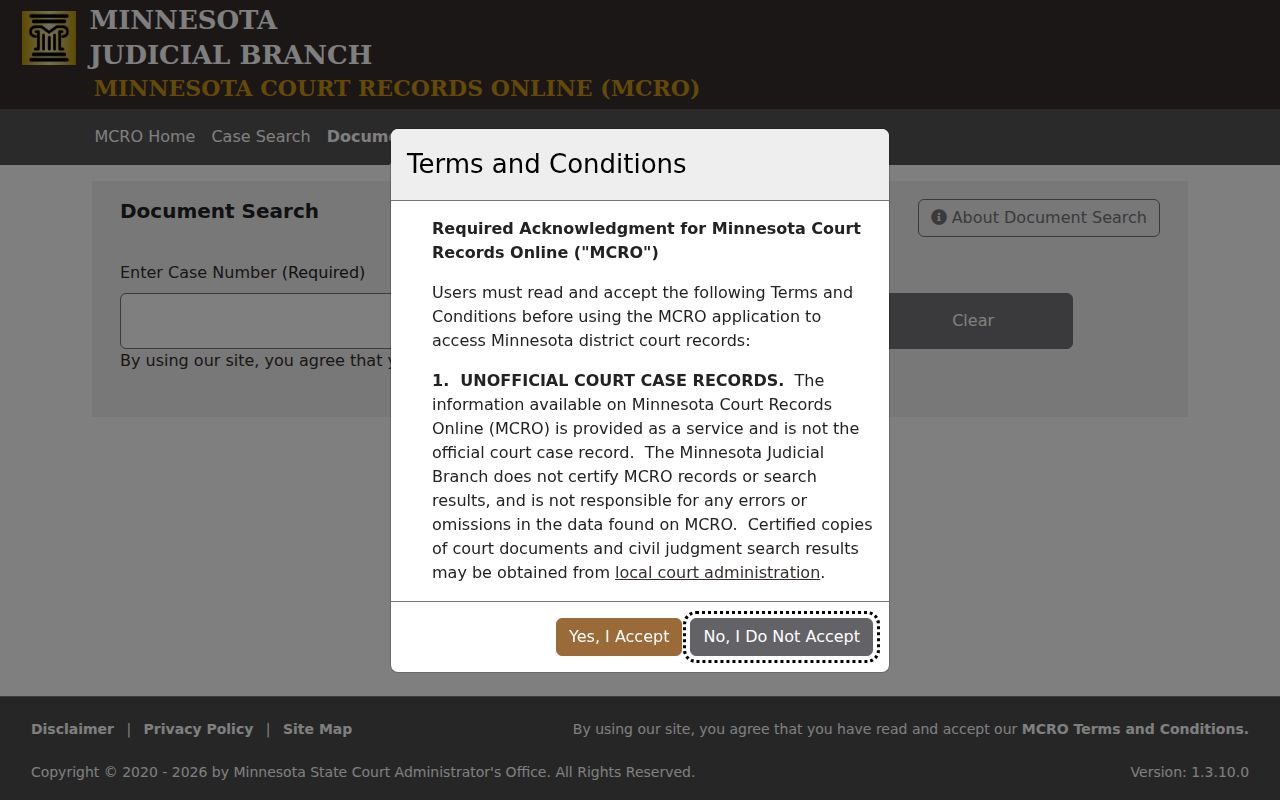
Run Case Search first, then bring the complete number to Document Search. That order keeps a partial identifier out of a form that cannot resolve it.
Inside a Todd County Court Record
A public Todd court record typically bundles basic case information with the Register of Actions, hearing details, permitted party and attorney roles, judgment information where relevant, and links to public documents. Appeals live elsewhere. The Court of Appeals keeps a separate appellate record system, so an appeal never shows up as just another entry in the local district-court file. eFS, Minnesota eFile and eServe, is the filing and service system for authorized filers. It is not the public court-record search.
| Court file number | The complete Minnesota case identifier. Todd calendar examples begin 77-, but a full private case number should not be guessed or published. |
|---|---|
| Case information | Category, court location, filing date, status, and public party or attorney role labels. |
| Register of Actions | The chronological record of filings, hearings, orders, and other recorded activity. |
| Hearing information | Public hearing date, type, location, and judicial officer information where the access rules permit it. |
| Documents and orders | Public document names, dates, orders, judgments, and other available filed material; availability is not universal. |
| Transcript or exhibit | A transcript is the reporter-created record of spoken proceedings; exhibits have separate Rule 8 treatment and may need court handling. |
Each record type answers a different question. A hearing calendar is only a scheduling snapshot. A Register event logs court activity, a document is the underlying filing or order, and a certified copy is an authenticated court product.
Todd Court Record Copy Requests
Start with the statewide court copy request form. It asks for the case type, the court file number, the county when the number is unknown, party names, a delivery choice, and space for up to four documents. For each one, give the document name or a clear description. Add its date or index number. Then pick the copy type and how many you want. Vague requests slow things down. Asking for "everything" makes the clerk hunt through more of the court docket than needed. It can also raise the search and production work on a Todd court record request.
Copy products are not all the same. The Judicial Branch copy-request guidance spells out the difference. A plain copy of a nonconfidential record can go out by fax or email. That holds where the court allows it. A certified copy carries the court's authentication. An exemplified copy adds the extra signature or seal steps that form of authentication requires. Check with the receiving office first. Order the product that office actually demands, because the wrong one will bounce back.
The official copy-request guidance lays out the copy categories. A Todd court record request can draw on them.
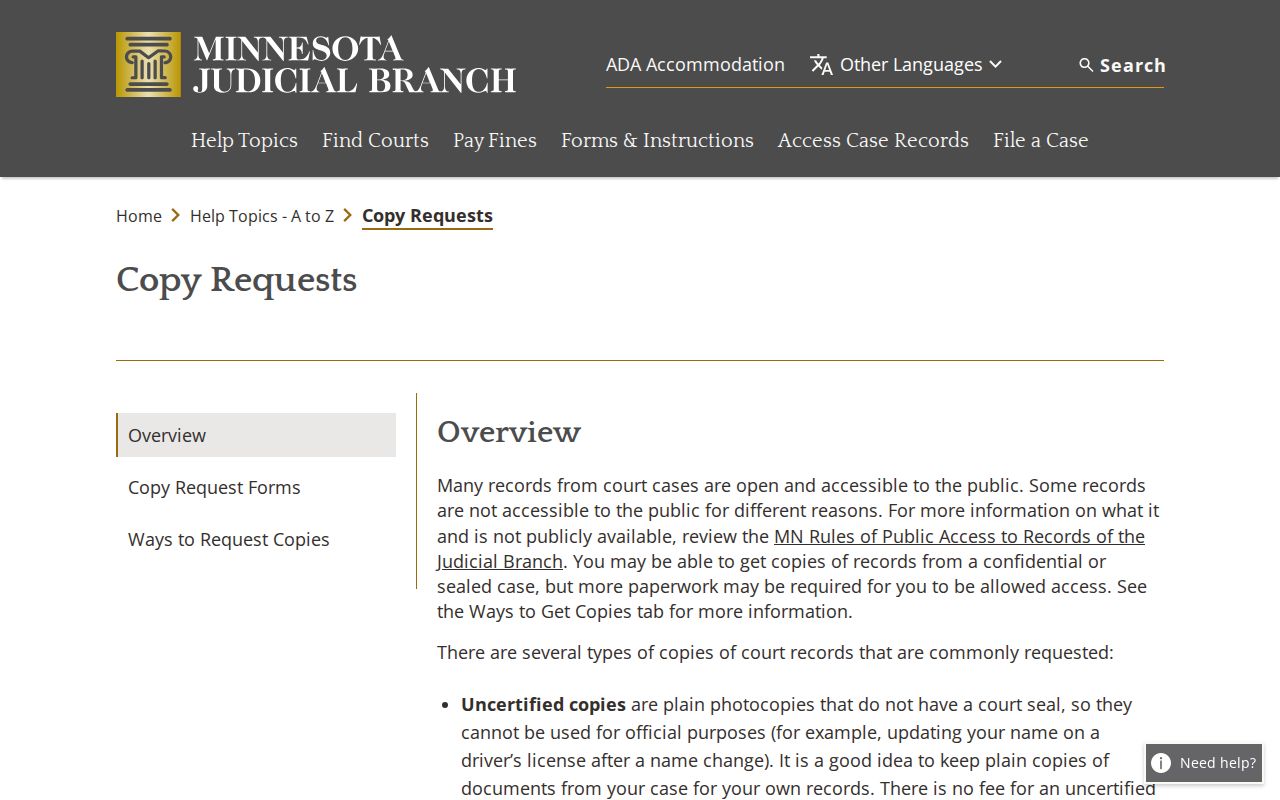
Fill in the document and copy type fields carefully. Those details give Court Administration what it needs to pull the right court record from the docket.
Fees and Certified Copies
Here is the fee picture. The statewide form lists plain copies at no fee. Certified copies run $14 per document, exemplified copies $14 per document, and certified plus exemplified copies $28 per document. Todd's district-court catalog also prices certified printouts of imaged or e-filed MNCIS documents, certified scans or pictures, and certified screenprints at $14. These are listed amounts, not a flat promise. Some requests take more production work than others. Confirm the current fee page before you pay for any court record copy.
| Requested court record | Listed amount |
|---|---|
| Plain copy on the statewide request form | No fee listed |
| Certified copy | $14 per document |
| Exemplified copy | $14 per document |
| Certified and exemplified copy | $28 per document |
| Todd scanning | $25 per 50 pages or part |
| Todd report, 1–50 pages | $5 per report |
| Todd report over 50 pages | $25 per 50 pages |
Scanning and report charges come from the Todd fee catalog. Verify them for the output you want. One catch: base fees may not include a county law-library charge. Make checks payable to the District Court Administrator. Before mailing anything, confirm the live instructions and the payment methods the clerk actually accepts.
Todd County Court Administration
Todd County Courthouse, 221 First Avenue S., Suite 100
Long Prairie, MN 56347
320-357-5005
Monday–Friday, 8:00 a.m.–4:30 p.m.
Todd Court Record Fees Versus County Fees
A district-court file never travels through the Todd County government data-practices process. For Minnesota District Court records, the route runs through MCRO, the court copy form, and Todd Court Administration. The county data-practices track handles county-government administrative data instead. It carries its own fee schedule, a prepayment practice, and a ten-day abandonment rule, and none of that overrides Judicial Branch records rules or unlocks a restricted court record.
Todd County's government data-request page offers free inspection of county government data and lists separate charges for searches, copies, media, faxing, and mailing. That path fits a county-agency record. It does not fit a Todd court file. Keeping the two processes straight saves you from a misdirected request and a wasted wait.
Sealed Records and Public Access
Public access in Minnesota runs on the Minnesota Rule of Public Access to Records of the Judicial Branch, Rule 8. That rule lets the public inspect and copy records where they are normally kept during working hours. Local procedure and the rule's own limits still apply. It also defines the register of actions. That is the list identifying each case title, origin, activity, proceedings, and filings. One caution applies. Remote access is narrower than what a courthouse terminal shows. A docket search online can miss what the terminal reveals.
Rule 8 access boundary: Court files can include public material, but Rule 8 and other law restrict juvenile, sealed, confidential, medical, and selected protected information. A public terminal does not override a statute, rule, or sealing order.
MCRO shows less for certain material. Juvenile cases, OFP or HRO matters, CHIPS cases, civil commitments, restricted exhibits, and confidential-address records may not appear. The same goes for a pending traffic or criminal case with no conviction on a defendant-name search. An online absence proves nothing. It does not mean a record was destroyed, cancelled, or closed to every permitted user, so treat a blank result on a Todd docket search as a gap, not an answer.
Todd Court Record Sealed Access
A copy request is not the first move for a sealed or confidential record. When a requester has a basis to seek judicial access, the CON100 and CON101 access packet is the right tool. CON100 states the request is not for adoption records. It lets you list multiple cases in one county on a single form. Each additional county requires a separate form. File the forms at the courthouse, by mail, or through eFS where permitted. The packet confirms there is no filing fee for the access request itself.
A judicial officer decides. If access is granted, submit the order with a separate copy request. Follow any limits the order spells out. The order governs who may see what. It never converts a sealed Todd court record into a public one. Call Court Administration to confirm current filing mechanics. Do not ask staff to sidestep a restriction.
Note: No universal Todd copy turnaround exists. Ask about timing, delivery, and current charges for the specific record you need.
For MCRO sign-in and search trouble, the MCRO support information separates portal help from the local records counter. That counter handles Todd court record questions.
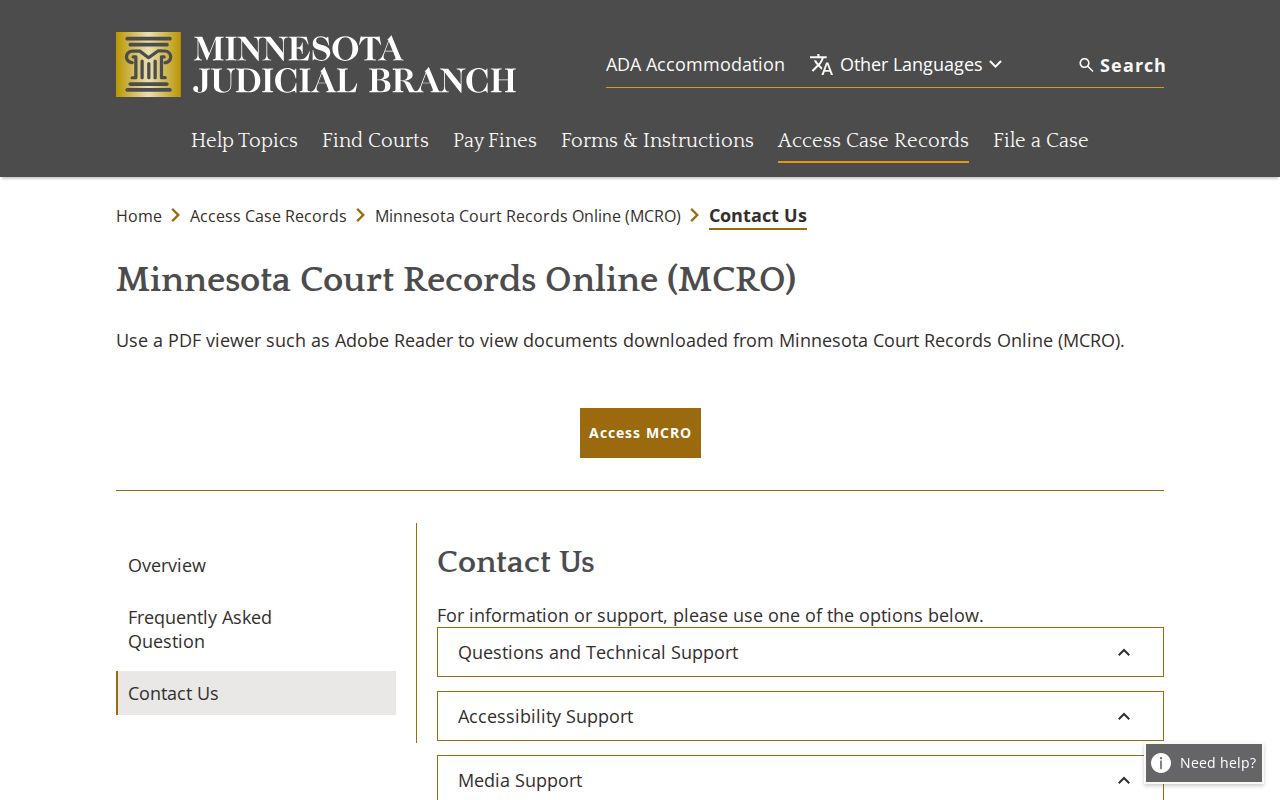
Technical assistance can fix an MCRO-use question; certification, local files, and access orders stay with Court Administration.