
Searching the Todd County Court Docket
Start with Minnesota Court Records Online, known as MCRO for any ordinary Todd County District Court matter. It is the statewide public search layer for civil, criminal, family, probate, juvenile, and traffic cases. Access rules still apply. Choose a search method first. When the filing county is known, select Todd under specific county court locations. MCRO works well for locating a case and viewing its public Register of Actions. Just remember what it is not. It does not turn a free online result into a certified court record.
Use the narrowest reliable detail you have. A complete case number or citation number works best. For a name search, try the exact spelling first. Then try a separate Sounds Like search or a trailing wildcard if the spelling is uncertain. A hearing question and a document request take different paths. The Todd daily calendar and the MCRO Hearing Search help with settings. Court Administration handles certified copies, locally held paper files, and anything remote access cannot resolve.
- Open MCRO Case Search and select Name, Case Number, Citation Number, or Attorney.
- Choose Todd County when the filing county is known.
- Add a category, date, or status filter only when it will narrow the result.
- Open View Case Details and read the Register of Actions in order.
- Use a public document link when available, or request the exact copy from Court Administration.
Note: A name result can be limited by spelling, access rules, or a pending-case restriction, so it should not be treated as a complete history.
Todd Court Docket Search Paths
MCRO offers four separate public search tools. Case Search comes first when you want a case and its Register. Document Search only works once you have a complete court file number. Hearing Search targets dates and settings. Judgment Search is a different query for public judgment information. The tools work together. A Todd County user with only a hearing date should not expect a document search to run by name.
| MCRO tool | Best use | Important limit |
|---|---|---|
| Case Search | Find a case and Register of Actions | Some matters are restricted or unavailable by name |
| Document Search | Find permitted documents | Requires the complete case number |
| Hearing Search | Find settings by date, person, case, judge, or attorney | A setting can change after the search |
| Judgment Search | Review public judgment details | It is not a full civil case search |
MCRO access guidance labels the public material unofficial. A downloaded record can still be useful, but Todd County Court Administration stays the local source for certification.
Inside a Todd County Court Docket
Minnesota names the chronological activity list the Register of Actions. In plain words, that is the docket. It is the court's own sequence of filings, notices, hearings, orders, and other recorded activity. A public case view may also show party-role labels and attorney information where public. It can include hearing details, judgment information, and links to permitted documents. A calendar row is not the Register. A linked filed document is not an authenticated copy.
| Court file number | The complete identifier for the case. Todd calendar examples begin with 77-, but that prefix alone cannot be searched as a full case number. |
|---|---|
| Case information | Category, court location, filing date, status, and public role labels. |
| Register of Actions | Chronological recorded events, with event date, type, and description where public. |
| Hearing details | Scheduled date, time, location, judicial officer, and hearing type when shown. |
| Documents | Public document titles and links where date, case type, imaging, and access rules allow them. |
| Disposition or judgment | A recorded outcome or court decision, read with its date and underlying order when available. |
Event labels are procedural information. A charge is not proof of guilt, a motion is not a ruling, and a future setting is not a final result. Reading the whole Register in order gives a truer picture of what the court has recorded.
Todd Court Docket Case Numbers
The Todd daily calendar visibly uses a 77- county prefix. The rest of the identifier matters just as much. Minnesota guidance describes a complete court number as a county code, case-type letters, a year, and a sequence. You may enter a complete number with or without dashes and leading zeroes. It cannot contain spaces. A citation number and a court file number are different identifiers. Either can lead to a traffic-related search.
Treat the prefix as a clue. Verify it in the official record; do not use it as a substitute for missing characters. When the full number is unknown, run a name search with a county, category, or filed-date filter instead. MCRO caps results at 200 and offers Newest First, Oldest First, Print, and View Case Details. Narrow the query rather than guessing a number or copying a private number from a calendar.
- Exact name
- The standard MCRO method using available last, first, and middle name fields.
- Sounds Like
- A spelling-variation option that cannot be combined with a wildcard.
- Trailing wildcard
- An asterisk used after at least two characters to broaden a name search.
- Citation number
- An identifier from a citation that is distinct from a court file number.
Courts That Keep Dockets in Todd County
Todd County District Court sits in Minnesota's Seventh Judicial District and serves as the county trial court of general jurisdiction. Local Court Administration handles the civil, family, probate, juvenile, criminal, and traffic matters named on the official court page. Conciliation Court is Minnesota's small-claims division within District Court. Juvenile Court and Probate or Mental Health are District Court subject areas, yet their access rules can differ sharply from an ordinary public civil or criminal case.
| Court or division | Todd docket coverage | Where to start |
|---|---|---|
| Todd County District Court | Civil, criminal, family, probate, juvenile, and traffic matters | MCRO with Todd selected, then Court Administration |
| Conciliation Court | Small claims within District Court | MCRO civil route; an appeal is a trial de novo stage |
| Minnesota Court of Appeals | Separate appellate records after an appeal | Appellate resources, not the ordinary Todd MCRO path |
| Federal courts | Federal civil, criminal, and bankruptcy records | PACER or the appropriate federal court system |
The Minnesota Judicial Branch court structure explains the statewide system. A city office, a county attorney, and a federal court are different custodians with different records. No separate verified municipal docket portal was found for Todd County's five profiled cities.
Minnesota's court structure page provides the statewide context for this hierarchy.
The distinction matters when you search. A Todd County trial-court record sits in a separate lane from an appellate or federal case lookup.
Todd Court Calendar Is a Snapshot
The Todd daily court calendar gives you one day's schedule, not the full docket. According to the official Todd court page, the searchable PDF goes up around 7:00 a.m. on business days. It also gets hourly updates. Columns cover Hearing Location, Hearing Date, Time, Judicial Officer, Hearing Type, Connection Type, and Case Number. It is not a promise. A listed hearing can shift, and unlisted cases exist.
Some matters stay off the PDF entirely. Confidential files and records that block remote access are never posted. A gap may mean a restriction, a fresh update, or a narrower record scope. When a hearing is time-sensitive, check the PDF against MCRO Hearing Search and then call Court Administration. For the most current daily reference, look at the printed calendars. These are posted outside courtrooms and in public lobbies.
One caution on labels. A connection label on the calendar names a participant's role. It is neither an invitation for the public to join a remote hearing nor any decision by the court.
How to Find Court Dates and Settings
Where does a Todd County court date show up? Three places, usually. The Register lists it, MCRO Hearing Search finds it, and the daily PDF covers scheduled public courtroom hearings. Bring a full case number if you have one. Hearing Search also works by name, judicial officer, or attorney, with filters for date, category, and county. For the next business day, the daily PDF is the quickest tool. Hearing Search wins when you want a wider date range.
Read the label on each setting with care. Todd calendar material uses terms like First Appearance, Arraignment, Omnibus Hearing, Pre-trial, Motion Hearing, Conciliation Hearing, Court Trial, and Sentencing. None of those labels is a result. A reset or continuance only moves a date. It never dismisses the case or decides anything on the merits. The Todd County Court Dates page walks through the full local calendar workflow.
Todd Court Docket Access Options
MCRO remote access is only one layer of Minnesota public access. It is not the whole courthouse record system. Every district courthouse keeps a public-access terminal for statewide electronic district-court records. At a terminal you may reach more than you can from home. Broader terminal access still bends to sealing orders, juvenile confidentiality, medical-exhibit controls, and other restrictions. Paper files from Todd County go through the courthouse and Court Administration.
Minnesota's access-records information lays out online access, courthouse terminals, local paper files, and the separate appellate path. A record may be older, restricted, or not imaged. Certified copies raise the same flag. Escalate all of these to Todd County Court Administration. Technical MCRO support troubleshoots the system but cannot replace the records counter.
The official Todd courthouse history records the Long Prairie courthouse and how it developed over time.
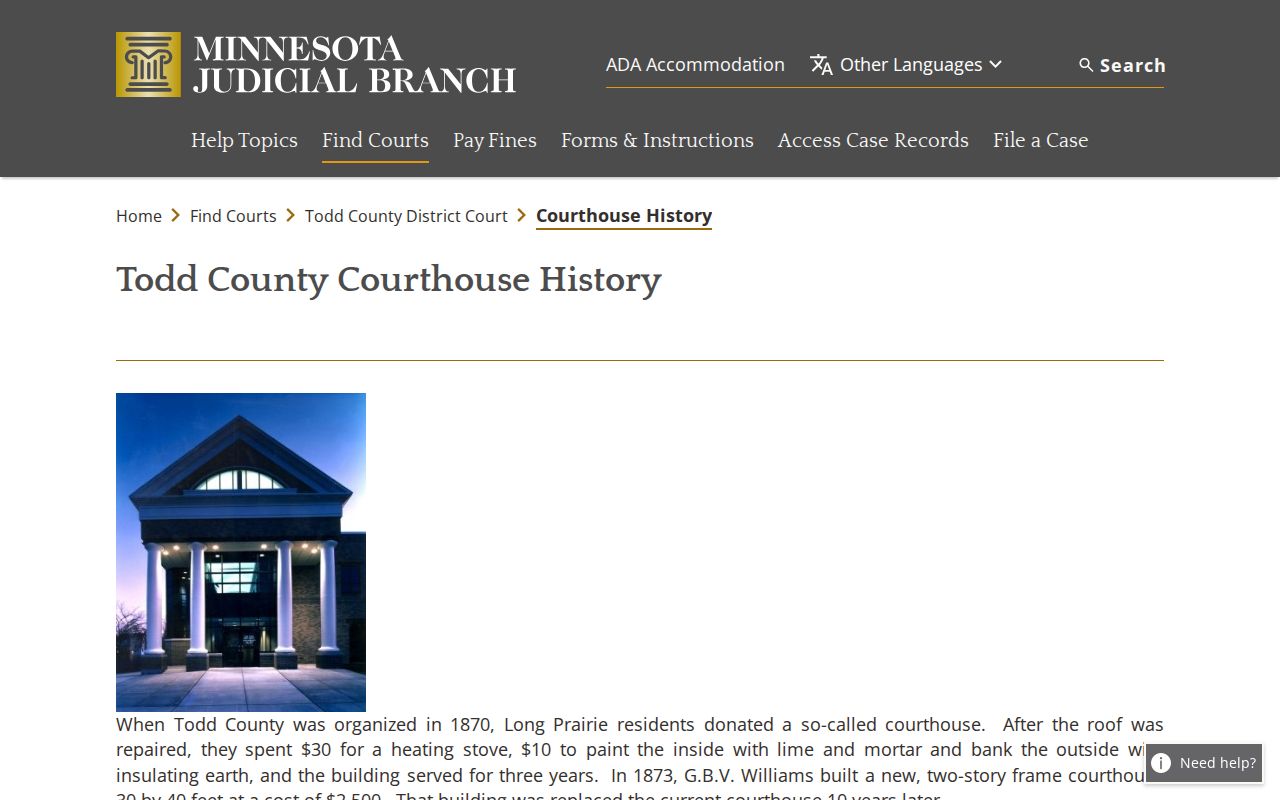
Even with MCRO handling statewide electronic search, the historic courthouse in Long Prairie remains the local home of Todd County Court Administration.
Public Access to Court Dockets
The backbone rule here is Minnesota Rule of Public Access to Records of the Judicial Branch, Rule 8. It gives the public the right to inspect and copy court records during normal working hours. The rule's limits and local procedure still apply. Rule 8 also defines the register of actions. That running list captures a case's title, origin, filings, and proceedings. One more distinction matters. Courthouse-terminal access and remote access are treated separately under the rule, so some docket material may sit behind the terminal only.
Key access rules:
Rule 8 permits public access while maintaining limits for remote and restricted material.
Minn. Stat. § 260B.163 generally makes juvenile hearings private, subject to its stated exception.
Minn. Stat. § 260B.171 gives separate treatment to juvenile legal and other juvenile records.
Minn. Stat. § 609A.01 addresses expungement and sealing; it does not make sealed records public.
Minn. Stat. § 13.03: this statute sets inspection and copying practices for Minnesota government data, though it cannot sweep aside court-record restrictions. Send county-government data requests to the county, and Judicial Branch requests to court staff.
Todd Restricted Court Docket Records
Some docket material stays off limits, and the law allows that. Juvenile hearings, OFP and HRO files, CHIPS cases, civil commitments, medical exhibits, sealed filings, confidential addresses, and certain family matters may be excluded from remote access entirely. Even public civil and criminal documents face limits tied to date, type, and classification. An older Todd County case may show up in a search. Its records still need a local inquiry.
A defendant-name search can also leave things out. Pending criminal, traffic, and petty-misdemeanor matters without a conviction may not appear. A full case-number search can act differently. An absence is not a conclusion about anyone. A requester may have a legal basis to see a sealed or confidential court record. The CON100 and CON101 process governs that judicial-access request. If the court grants it, that order controls the later copy request.
Docket Records at the Clerk's Office
Todd County Court Administration is the local contact for court records. There is no separate civil or criminal clerk office here. Court Administration covers the District Court subjects listed for Todd County. Certified copies are its job too. So are paper files, older records, and questions about a specific filing. Authorized filers use Minnesota eFile and eServe to file and serve documents. That system is not the public case-search service.
Todd County Court Administration
Todd County Courthouse
221 First Avenue S., Suite 100
Long Prairie, MN 56347
320-357-5005
Monday through Friday, 8:00 a.m. to 4:30 p.m.
A copy request works best when it is specific. Include the case type, the court file number or county, and a document description. Its date or index matters too. So do the copy type, quantity, and delivery method. The statewide form treats plain, certified, exemplified, and combined certified-plus-exemplified copies as different products. Court Administration can explain routing, payment, and availability before anything is sent. The official judicial directory identifies the Todd County judicial location.
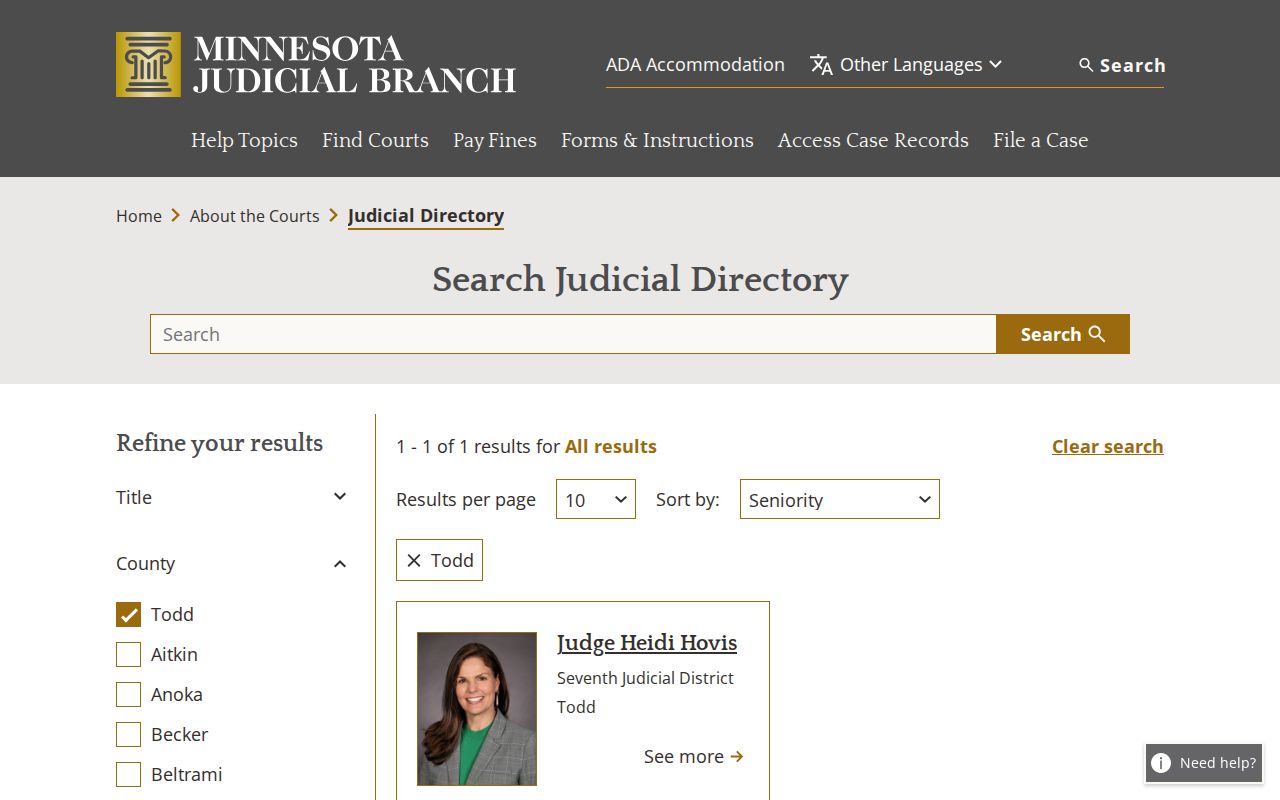
The directory shows the local office and the statewide system belong to the same Minnesota Judicial Branch.
Todd Court Records Need Custodians
Who holds a Todd County record depends on what that record covers. Court case activity and the Register of Actions sit with MCRO. So do certified judicial copies from Todd County Court Administration. County business follows a different lane. Policies, contracts, and administrative files move through the Todd County data-practices process. City material belongs to that city's own custodian. That covers an ordinance or a utility record. Federal cases live in PACER or the federal court. And note that the county attorney prosecutes cases but keeps no District Court Register.
For civic orientation, the Todd County government page lays out county offices. It also helps explain why a county-office route differs from a court-record route.
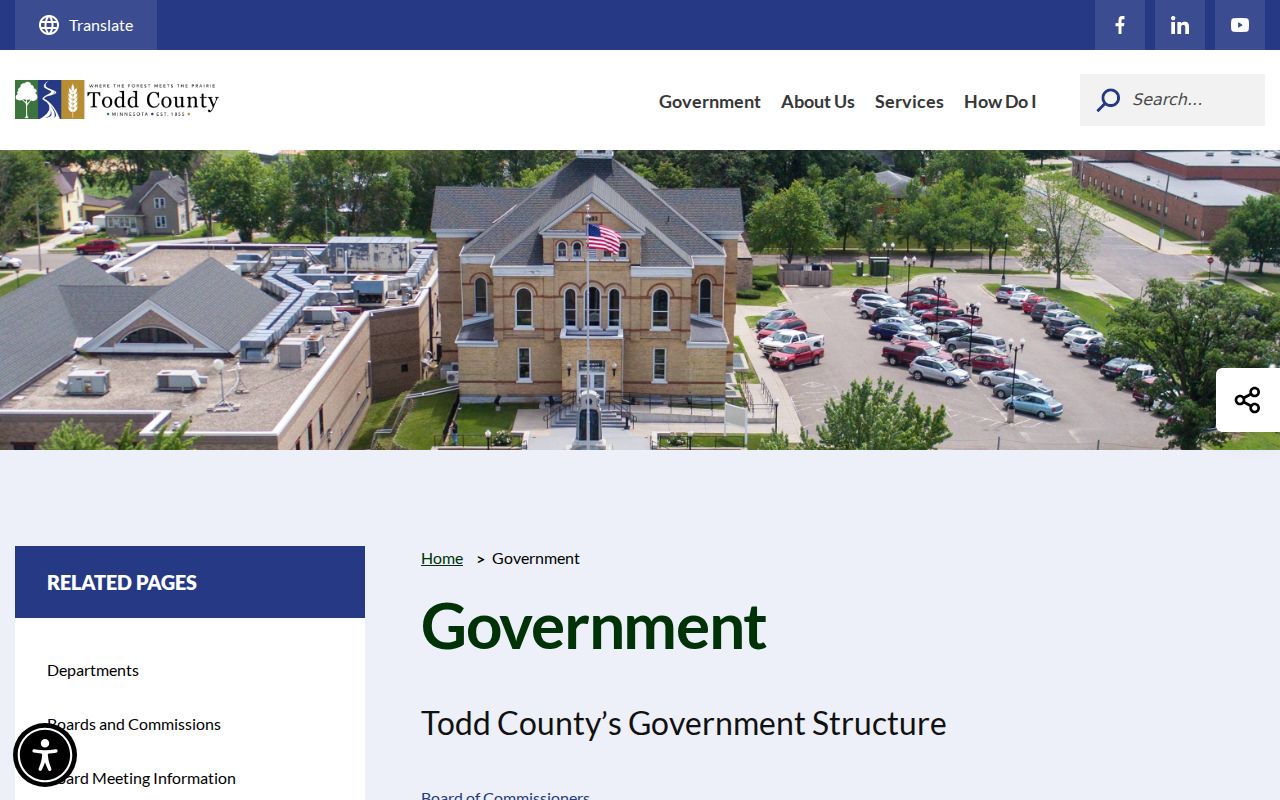
County-government material makes decent civic context. It still cannot stand in for the court's own records system when you need a case file.
Todd Court Docket Technology History
Docket access in Todd County has changed a great deal. Paper ledgers and courthouse visits came first. Then statewide terminals arrived, and eventually MCRO. Minnesota's own MCRO timeline marks the milestones: document access began in 2021, Case Search launched in December 2021, hearing and judgment functions arrived by August 2022. MPA Remote was replaced on April 17, 2023. So a Todd County court docket search today runs through a statewide electronic layer paired with the local court office, not a separate Todd clerk portal.
The courthouse itself still matters. When online material runs thin, the building is where you go. Todd County history supplies local background, while the live court page posts current closures, access procedures, and calendar information.
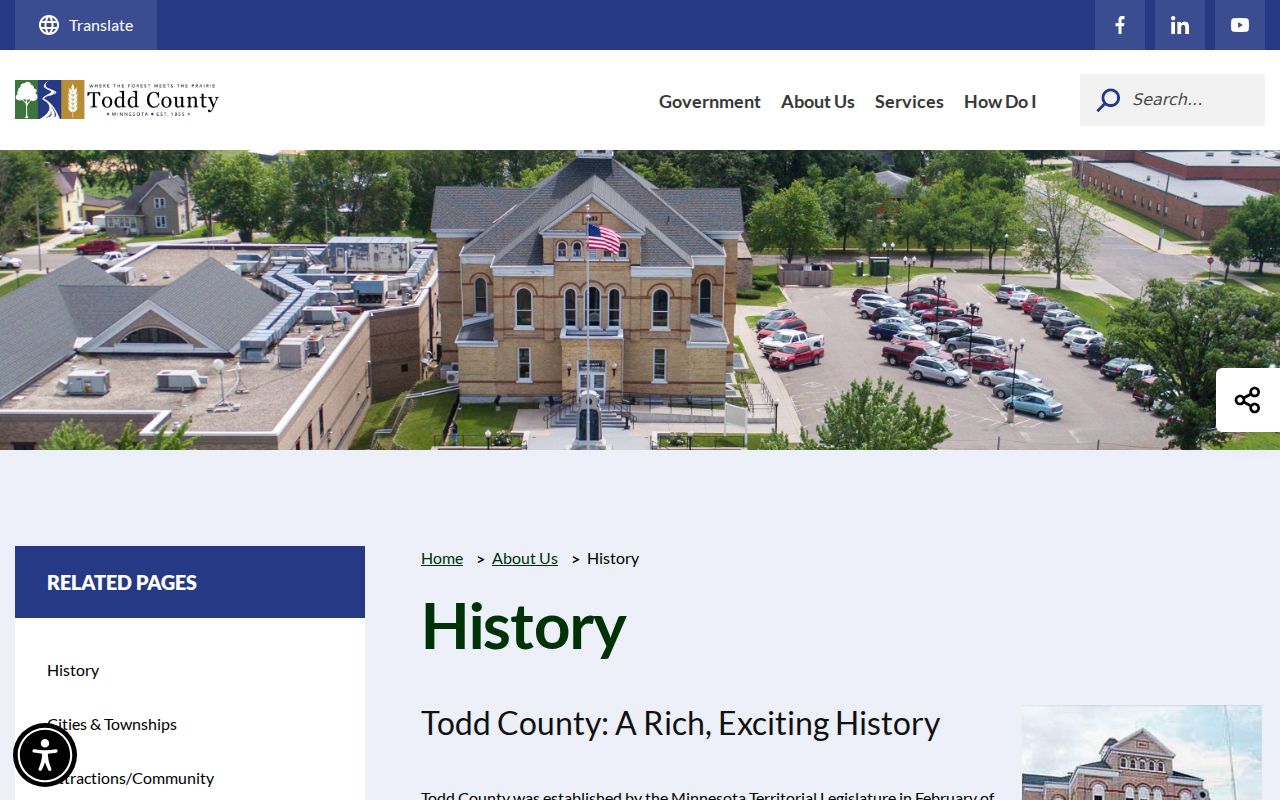
That historical record frames how the courthouse grew alongside a court system that now leans on both local service and statewide digital records. Context helps when you are tracing an old docket entry.
Todd Court Docket City Routes
Todd County holds twelve incorporated cities. Its five largest under the 2020 Census incorporated-place table all share one statewide District Court access route. None runs its own municipal docket portal. City offices still do plenty. Ordinances, permits, utilities, and council material stay with them. For an actual court record, use the filing county, MCRO, or Court Administration. Osakis deserves a caution, since the city straddles Todd and Douglas Counties.
Todd County's cities and townships page lays out the municipal landscape behind these local routes.
That city reference helps separate municipal information from the state court docket that actually serves a city resident. The distinction saves time.
Todd County Court Dockets by City
Each city page keeps civic routing clear. None assumes a City Hall portal doubles as a court docket. The figures come from the 2020 Census incorporated-place table. They measure residents rather than court caseloads. Every page points back to the state and county court routes already verified, while noting that municipal forms, council meetings, and utility payments belong to a different office entirely.
Long Prairie Docket Search
3,661 in 2020. County seat, with City Hall and Court Administration at separate addresses.
Staples Docket Search
2,989 in 2020. Municipal payment navigation is not the court payment route.
Osakis Docket Search
1,771 in 2020. Confirm whether a filing belongs in Todd or Douglas County.
Browerville Docket Search
839 in 2020. Prosecution context is not a separate city docket.
Clarissa Docket Search
661 in 2020. City-government and District Court records have separate custodians.
The 2020 Census incorporated-place table is the source for this top-five ordering.
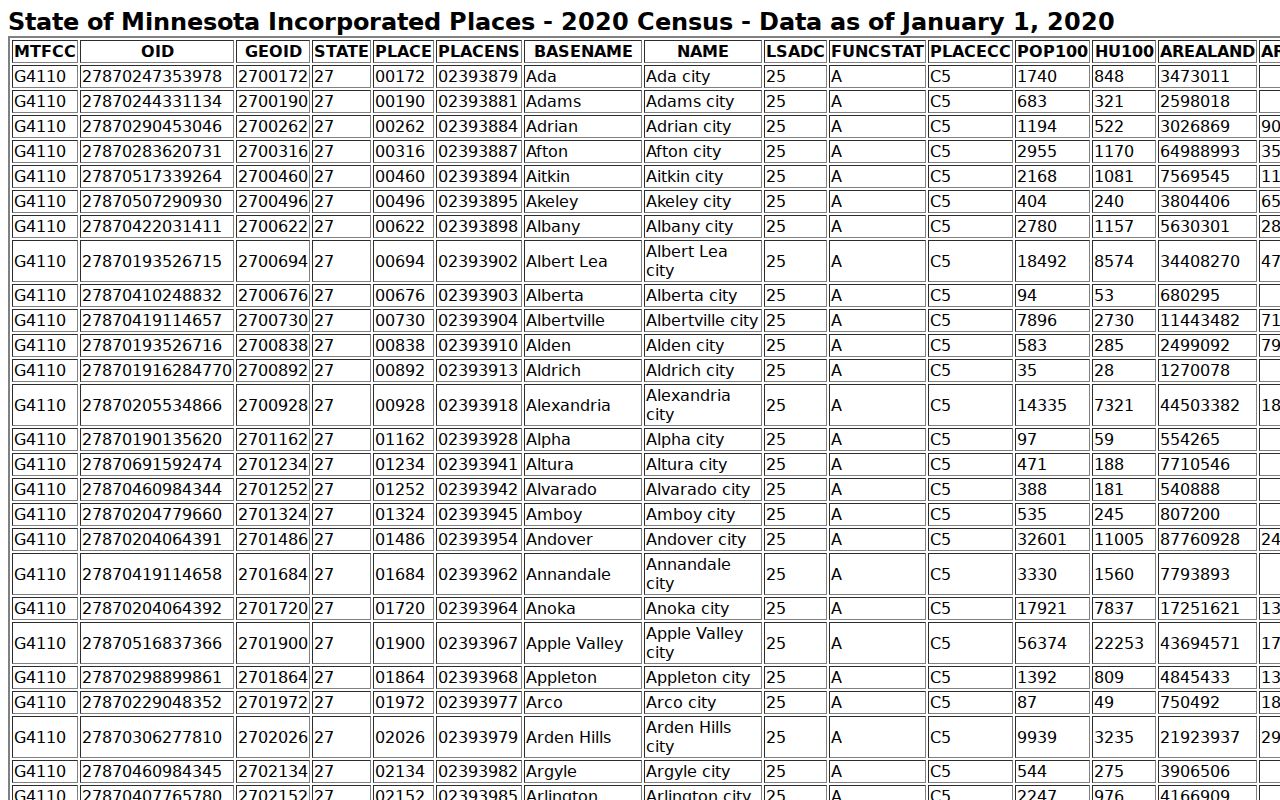
The population table simply organizes city-level routing; it does not measure court cases in any Todd County community.
Todd Court Docket District Context
Todd County sits in the Seventh Judicial District, which covers ten counties. The Judicial Branch reported 68,995 total filings district-wide in 2023, spread across criminal, civil, family, juvenile, and probate or mental-health categories. Those are district numbers, not Todd County numbers. A local case is plainly administered within a statewide court model. The district total says nothing about activity at the Todd County courthouse.
Do not treat that figure as a Todd filing count. It is not a city caseload either. For current published statistics, the Minnesota court dashboards are the right source. Each figure there comes with its stated geography.
Map and Directions to the Todd County Courthouse
Todd County District Court files, covering civil, family, probate, juvenile, criminal, and traffic matters, are kept at the Todd County Courthouse in Long Prairie. Court Administration works out of Suite 100; county-government offices use a different suite in the same building, so confirm the destination suite before a visit.
Todd County Courthouse
221 First Avenue S., Suite 100
Long Prairie, MN 56347
320-357-5005
Monday through Friday, 8:00 a.m. to 4:30 p.m.
The courthouse offers a free public surface lot and free on-street parking. No accessibility or security-screening protocol was published on the official location page, so call Court Administration ahead of a time-sensitive visit for accommodations or an older, certified, or restricted record.